Your Final Financial Decision May Be Your Most Important One

In 2017, my wife and I made an important financial decision.

We upgraded from having a will to establishing the Riddick Family Revocable Trust.

This picture was taken after we finished signing the documents. At the time, it felt good to have another important piece of our financial plan in place.

Fast forward to today, and I've come to appreciate even more why estate planning is an important part of financial wellness.

During my years as a financial wellness coach, I've met people who have spent months paying off debt, building emergency funds, and investing for retirement. Yet many of those same individuals have never created a will or reviewed the beneficiaries on their financial accounts.

When we think about financial wellness, we tend to focus on budgeting, saving, investing and getting out of debt.

But what happens to everything you've worked so hard to build if you're no longer here?

That's where estate planning comes in.

August is National Make-A-Will Month, making it a good time to ask yourself:

Do I have a will?

Are the beneficiaries on my retirement accounts, life insurance policies and other financial accounts still correct?

Have I considered whether a Payable-on-Death designation makes sense for my bank or credit union accounts?

Life changes. Marriage, divorce, children, grandchildren and the loss of a loved one can all be reasons to review and update your estate plan.

I don't believe estate planning is just for wealthy people. If you've worked hard to build something, you should also think about how to protect it and make things easier for the people you love.

If creating or updating your will has been sitting on your to-do list, maybe August is the month to finally take care of it.

The American Red Cross offers a free resource to help you get started, and Experian provides information about Payable-on-Death accounts. I'll put both resources in the comments.

A winning financial game plan isn't just about building wealth.

It's also about protecting the people you'll one day leave it to.

How One Coaching Client Found an Extra $375 Per Month

Helping people create simple, repeatable financial systems makes me happy.

Recently, I completed a session with a private financial wellness coaching client I’ll call “Mike.” Like many people, he was working full-time but still felt like his money disappeared every month.

In just four, 1-hour coaching sessions, Mike “discovered” an extra $375 per month in his budget. That’s $4,500 per year. He also started building an emergency fund.

The interesting part? He didn’t increase his income or start a side hustle.

Instead, he became more INTENTIONAL with his money.

That looked like:

✅ Eliminating subscriptions that weren’t adding value to his life

✅ Stopping the habit of giving money he couldn’t afford to give

✅ Changing the way he viewed money and financial decisions

One of my favorite moments was hearing the excitement in his voice as he explained his financial plan for the rest of the month. For the first time in a long time, he felt in control.

Here’s the wild part: I don’t know his take-home pay, and I don’t know how much debt he has.

Why? Because sustainable financial change is often less about complex math and more about building behaviors and systems that fit your real life.

That’s the foundation of the Game Time Budgeting system.

What am ATM Receipt Taught Me About Money

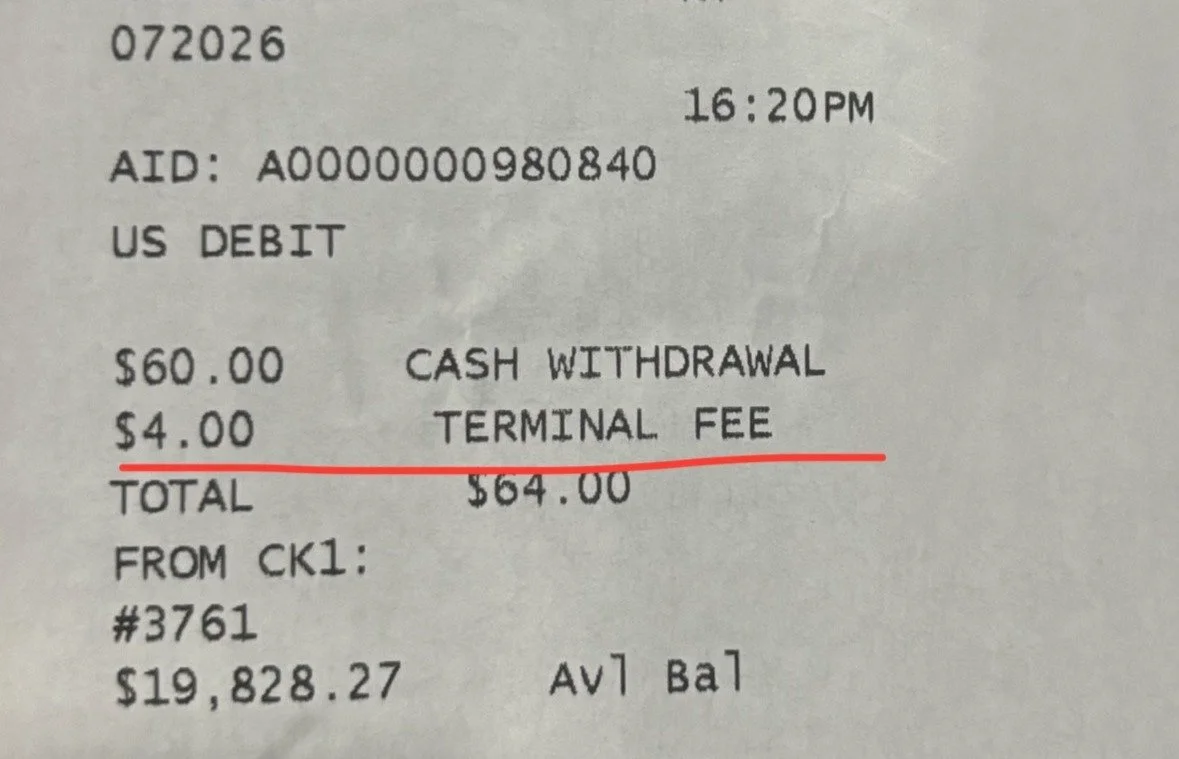
I needed some cash while walking through the airport on Monday, so I stopped at an ATM. Someone had forgotten to take their receipt, and what I saw turned into an unexpected financial wellness lesson.

 A $60 cash withdrawal.

 A $4 ATM fee.

 That means they paid 6.67% just to access their own money.

 What surprised me even more was something I didn't notice until about 48 hours later: their available balance was $19,828.27.

Whether someone has $200 or nearly $20,000 in their account, paying unnecessary fees is one

of the easiest ways to let money quietly slip away.

Think about it:

A $4 fee may not seem like much.

But if you paid that fee once a week, that's $208 a year.

That's money that could have been invested, added to an emergency fund, or used toward a financial goal instead.

Financial wellness isn't just about how much money you have. It's about developing habits that help you keep more of it.

Teachable moment: Before traveling, check whether your bank has fee-free ATMs where you're going, or consider getting cash before you leave home. Small decisions like these can have a big impact over time.

What's the most unnecessary bank fee you've ever paid?

Don't Waste the Second Half of 2026

We’ve hit the financial halftime of 2026.

Back in January, you may have planned to save more, pay down debt, invest, or increase your retirement contributions.

Now, check the scoreboard.

Are you on pace to reach your goals?

If yes, keep running your system. If no, don't just focus on the goal. Focus on the system producing your current results.

Here's something to think about:

If you don't give your money instructions and then verify those instructions were followed, who will?

Halftime is the perfect time to make adjustments so you can finish the year strong.

The $97,000 Lesson: Why Behavior Matters More Than Income

One of my private coaching clients—let’s call her Sarah—has an impressive educational background, including a degree from a top university and a law degree.

But like many people in their early 20s, she hadn’t yet mastered personal finance.

After graduating from college, her mom asked a simple question:
“How much do you owe in student loans?”

“$40,000,” Sarah replied.

Her mom immediately wrote her a check for the full amount.

Instead of paying off the loan, Sarah spent the money.

At the time, it didn’t seem like a life-altering decision. But over the years, it became an expensive lesson.

When we first connected in April 2022 following a financial wellness webinar at her company, Sarah was earning a six-figure salary—but financially, she felt stuck.

She had:

  • Student loan debt

  • Car loans

  • Credit card balances

  • A net worth of approximately $64,000

Through our coaching sessions, Sarah began to transform her financial life. Not through shortcuts or drastic measures—but by focusing on behavior.

She learned how to:

  • Identify her spending triggers

  • Replace old habits with better ones

  • Build a simple, repeatable financial system

Fast forward to April 2026, and Sarah reached a major milestone:

She became completely debt-free, including paying off her student loans.

Her net worth grew from $64,000 to $349,000—a 446% increase in four years.

But here’s where the story really hits home.

By the time she paid off her student loans, the interest alone had added up to $17,000.

When you factor everything together:

  • The original $40,000 loan

  • The $17,000 in interest

  • The $40,000 gift that was spent

Sarah effectively paid $97,000 to resolve a $40,000 debt.

Reflecting on that decision, she said:
"That was stupid."

But she didn’t stay stuck in that mistake.

She followed it up with something even more powerful:

"If you had told me when we first met that my life would look like this now, I wouldn’t have believed you."

That’s the transformation.

Not perfection. Not luck. Not even income.

Behavior change.

Your financial past may explain where you are—
but it doesn’t have to determine where you’re going.

I Retired the Day I Started My Business

A friend of mine owns a dental practice, and his story is one I often think about when people ask what financial success really looks like.

When he graduated from dental school, he didn’t celebrate by upgrading his lifestyle. He kept driving his old car and focused on eliminating his student loan debt as quickly as possible. While many new professionals reward themselves right away, he delayed that gratification.

He also didn’t do a lot of traditional saving early in his career. Instead, he invested heavily in building his dental practice. The business was his primary asset, and he treated it that way.

Fast forward to today—he’s 52 and semi-retired.

His house is paid off. His condo is paid off. The commercial building that houses his practice is paid off. All of his dental equipment is paid off. And because he built a strong practice, he now employs other dentists.

At one point he asked himself a simple question: “Do I really need to be here every day?”

The answer changed how he works.

Today he works two weeks on and two weeks off. He still performs dental surgery because he genuinely enjoys the work. As he told me with a smile, “There’s only so much golf I can play.”

What struck me most during our conversation were a few things he said about goals and discipline.

“You can’t wish upon a star. You have to put foot to pavement.”

“I put so much effort in on the front end of my career that I could retire earlier than I thought.”

And this one made me laugh: “I do more before 9 a.m. than most people do all day.”

Hard work and consistency were the foundation of everything he built. But he also believes clarity matters. He often tells younger dentists to start by asking themselves one question:

“What is it that I really want and desire out of my life?”

Once you know the answer, his advice is simple: “Stay in your lane and handle your business.”

He also warns young dentists about lifestyle creep. Going straight from a Geo Prism to a G-Wagon might feel good—but it can slow down your financial progress.

But the most powerful thing he said about retirement was this:

“I retired on the first day I started my business.”

In his mind, the goal was never just to stop working. The goal was to build a life where he could choose how he works.

I Made $1 Million Doing Nothing

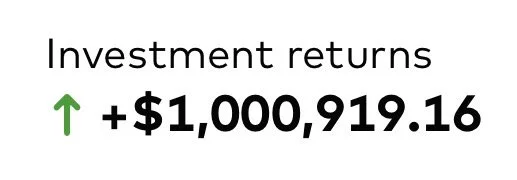
On February 26, 2026, I logged into my Vanguard account and saw something I’ll never forget:

My investment returns — capital gains, dividends, and interest — had surpassed $1,000,000.

One million dollars.

And I didn’t “work” for it.

Years ago, I made two decisions:

  • Invest instead of spend.

  • Reinvest every dividend automatically.

That’s it.

No stock picking.
No market timing.
Just disciplined behavior repeated over and over.

The Shift That Changed Everything

When you spend money, that becomes income for someone else.

If you want money to become income for you, it has to reproduce.

I often say, “You have to get your money pregnant.”

Those investments?
They’ve produced over a million babies.

And I didn’t babysit them — I built a system and let it run.

Consumption vs. Investor Mentality

On May 7, 2019, I found $12 in a Kroger parking lot.

Most people would think: free lunch.
I thought: future return.

I deposited it so it could be invested.

That moment didn’t start my journey — it revealed my mindset.

Consumers ask, “What can I buy?”
Investors ask, “What can this become?”

The System Never Changed

As my income grew, the system didn’t change.
As my investments grew, the habits didn’t change.

Money came in.
A portion was invested.
Dividends were reinvested.
Repeat.

Most people repeat behaviors that keep them in the same place.

What if you repeated behaviors that moved you forward?

You don’t build wealth by accident.
You build it by design.

When Love Meets Preparation: The Financial Side of Saying Goodbye

On January 25, my dad, Alfred D. Riddick, Sr., passed away. Like most families, we were grieving—emotionally, spiritually, and physically. What we were not doing was scrambling for money or information. And that mattered more than I can fully explain.

The total cost of my dad’s funeral and repast exceeded $15,000. Because my parents had been intentional and responsible with their finances over the last 15 years of his life, there was no GoFundMe page, no urgent calls for help, and no financial panic. Every expense related to the funeral was paid within 24 hours.

Just as important, my mom didn’t have to carry unnecessary stress. All the key documents—insurance policies, account information, and clear instructions—were organized and stored in a safe deposit box. Once we received notarized copies of the death certificate, my role was straightforward: contact the appropriate companies and begin the claims process. No guessing. No digging. No confusion.

But here’s the part many families overlook.

When a spouse passes away, the household income often changes immediately.

Because my mom is the surviving spouse, she will now receive my dad’s Social Security benefit since it was the larger of the two. Her Social Security check will stop. In addition, the retirement check my dad received from the State of North Carolina will also stop. Practically speaking, my mother will now live on roughly 50% of their previous household income.

That is a significant financial shift.

This is why it makes sense to enter your golden years with as little debt as possible—no mortgage payment, no consumer debt, no unnecessary financial obligations. When one spouse transitions, the emotional loss is profound. The financial impact is real. The last thing a surviving spouse needs is the pressure of fixed expenses built on a two-income retirement.

Preparing financially for your transition isn’t morbid—it’s an act of love.

The benefits of preparing in advance include:

  • Reducing emotional and financial stress for your loved ones

  • Ensuring funeral expenses can be handled quickly without debt or fundraising

  • Providing clear instructions and access to important documents

  • Minimizing confusion and delays during an already difficult time

  • Structuring retirement so the surviving spouse can live with stability and dignity

My dad gave us many gifts. One of the last was peace of mind.

If you haven’t prepared yet, let this be your reminder: planning ahead isn’t about fear—it’s about love, leadership, and protecting the people who will one day have to carry on without you.

One of the things my dad talked about during his final year was making it to 81. He would joke that the Bible promised “three score and ten” (70 years), so the extra 11 were his bonus years.

Me and mom reviewing her new budget effective February 1, 2026.

Prices Are Rising… But Spending Doesn’t Have To

A Lesson in Controlling What You Can

Recent news reports highlighted rising grocery and utility prices over the past year. That prompted Al to take a closer look at what those increases actually meant inside his own household.

The results told a different story.

From 2024 to 2025, grocery spending in the Riddick household decreased by $1,298. Utility spending? Increased by $71.

The takeaway was simple—but powerful: there’s a difference between price and cost.

Prices are external. They’re set by the market.
Costs are personal. They’re driven by behavior, choices, and systems.

While no one can control the price of groceries or utilities, everyone can influence their cost by shopping intentionally, tracking spending consistently, and understanding their numbers. That clarity makes it easier to separate economic noise from personal reality—and focus energy where it actually matters.

Why Controlling the Cost Matters

  • You stay empowered instead of overwhelmed.
    Rising prices don’t have to derail your plan when you control your spending decisions.

  • You adjust faster and smarter.
    Tracking reveals where small habit changes can create meaningful savings.

  • You build confidence through data—not headlines.
    Your numbers tell a clearer story than the news cycle ever will.

  • You maintain momentum toward your goals.
    Intentional spending keeps progress moving forward, regardless of market conditions.

Game Time Reminder:
Financial success isn’t about predicting the economy—it’s about mastering your behaviors and systems so you can thrive in any environment.

If you want a simple, easy-to-follow system to save more, reduce debt, and improve your quality of life, check out these resources: https://gametimebudgeting.com/resources

Tis the Season to Reflect on Your Money Story

A person’s relationship with money doesn’t begin when they open their first bank account or got their first job. It begins much earlier—shaped by what they saw, heard, and experienced growing up.

For example, when Al Riddick was around 10 years old, he believed that anyone driving a BMW or Mercedes-Benz must be rich. To his young mind, the car in the driveway was the clearest sign of financial success.

Over time, he discovered that wasn’t always true. Income doesn’t equal wealth. Possessions don’t equal financial stability. And appearances definitely don’t equal freedom.

This realization led him to ask one of the most important financial questions of his life:

“What do I believe about money… that might not actually be true?”

Many adults continue to carry childhood beliefs—some helpful, some harmful—into their financial lives.

Al encourages reflection on questions such as:

👉 What experiences—positive or negative—have shaped the way you view personal finance?
👉 What childhood money lessons still influence your decisions today?
👉 Which beliefs might need to be challenged, updated, or released?

Everyone’s money story is powerful—but it doesn’t have to define their financial future.

The Hidden Cost of Convenience: Beware of Surveillance Pricing

Every click, swipe, and online search tells a story—and companies are listening closely. This digital eavesdropping has given rise to surveillance pricing, a strategy where retailers quietly adjust prices based on what they know (or think they know) about you.

Here’s how it works: When you shop online, companies collect data such as your location, browsing history, income indicators, and even the type of device you’re using. Then, using algorithms, they personalize prices to match what you’re likely willing to pay. Two shoppers could look at the exact same item—say, a pair of running shoes—but see two different prices. One person might get a discount, while another pays more simply because the data suggests they can afford to.

It’s a modern twist on an age-old sales tactic—only this time, the negotiation happens behind the scenes.

So how can you protect yourself?

  • Shop in incognito or private mode. This prevents websites from using your browsing history to influence prices.

  • Clear cookies regularly. These small files track your habits across multiple sites.

  • Compare prices on multiple devices or browsers. You might be surprised by what you find.

  • Avoid clicking ads or emails directly. Go to the retailer’s site on your own instead.

Surveillance pricing isn’t illegal—but it’s a reminder that data has value, and someone is always calculating yours.

At Game Time Budgeting, we believe informed consumers make better money decisions. Whether it’s budgeting, saving, or outsmarting hidden costs, remember: the more you understand how money moves around you, the more control you keep over where it goes.

How Al Failed as a Son

In 2023, my dad had an aneurysm. Overnight, my mom, Alice, took on responsibilities he had handled for decades—paying bills, managing accounts, keeping track of deadlines. At first, she dove in with enthusiasm. She loved learning how their finances worked and even seemed excited by the challenge.

But by September 2025, I could see the change. Paying bills had become just another task on her long list. During a visit, she showed me paperwork about an increase in her auto insurance premiums. Without a second thought, I got on the phone, called the insurance representative, and resolved it—saving her money, just like I always do.

Later, as we were reviewing their monthly budget and talking about small tweaks to reduce stress, she said something that hit me like a lightning bolt: “I don’t want to run out of money.”

At that moment, I realized I had failed as a son.

Because my mom trusts me with financial decisions, I had gotten into the habit of giving answers instead of teaching her to think through situations herself. She had been carrying unnecessary worry—feeling like she might run out of money—when I knew it was impossible based on how they live and spend. My mistake wasn’t helping her—it was not showing her why her money was safe. I had robbed her of confidence in her own financial decisions.

I wanted to protect her from stress, but in doing so, I created it. The lesson hit me hard: teaching someone how to think about money is far more powerful than solving problems for them.

Key Takeaways:

  1. Teach, don’t just fix: Empowering someone to make their own decisions builds lasting confidence.

  2. Financial understanding reduces stress: Explaining why something is safe can prevent unnecessary worry.

  3. Trust is not enough: Being relied on is valuable, but showing how and why decisions work nurtures independence.

Old School vs. New School Money Management

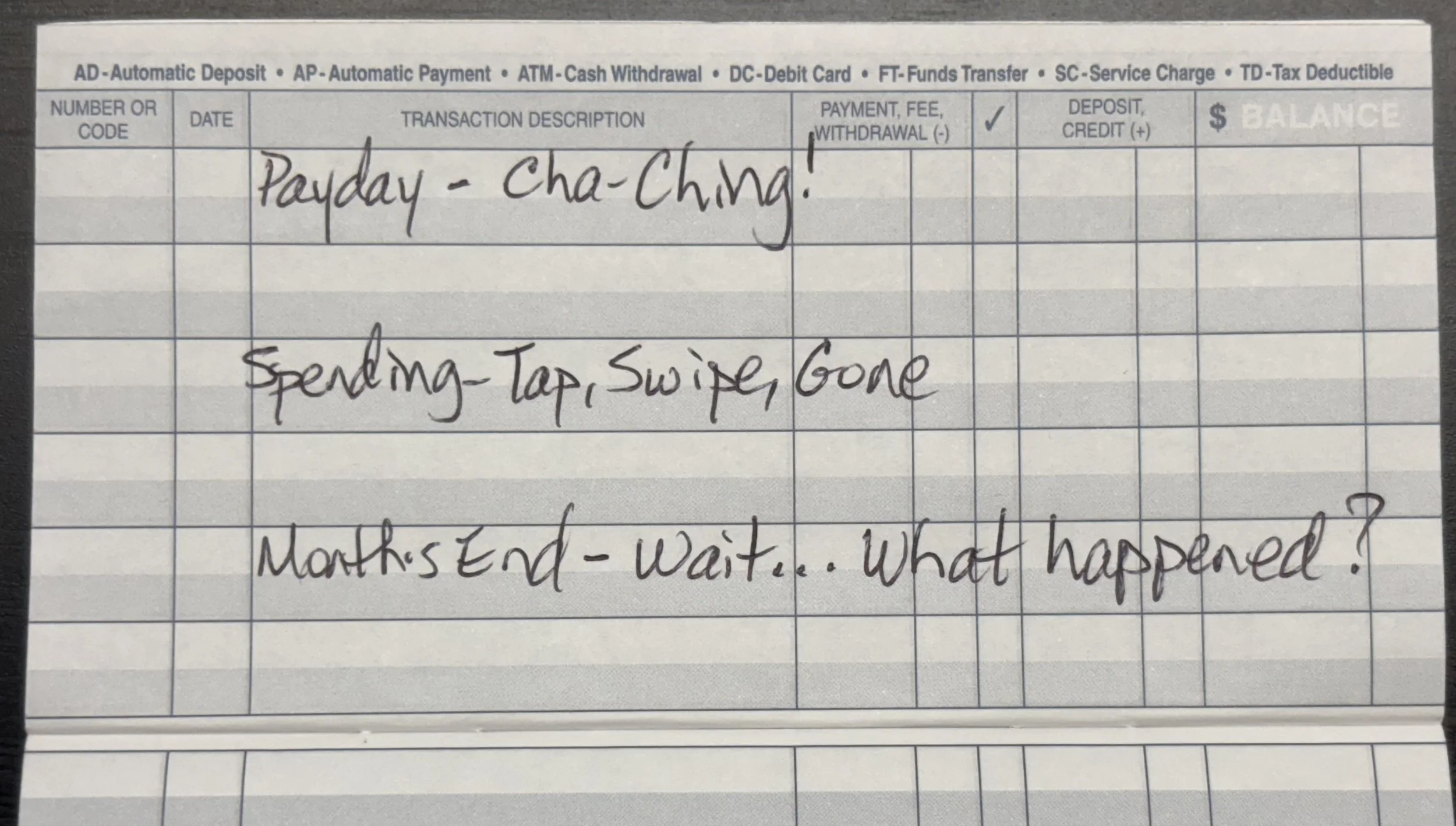
When Al recently came across an old checkbook transaction register, it sparked a reflection on how money management has changed over the years.

In the “old school” days, every purchase was written down, balances were updated by hand, and people always knew—almost to the penny—where they stood. Today, banking apps and digital wallets provide instant access to balances with just a tap. The pro is obvious: convenience. The con is subtle: as Al’s wife, Lesia, put it best—“Sometimes when things are convenient they aren’t top of mind.”

That simple act of writing down transactions created space for intentional reflection about spending. Now, with everything automated, it’s easy to lose track of habits.

Whether old school or new school, Al believes financial wellness isn’t about the tool—it’s about the awareness. Because at the end of the day, true money management is more than checking balances; it’s checking behaviors.


A Smart Checklist for Helping Aging Parents

Caring for aging parents can be tough, especially when it comes to handling their money and medical needs. Many families wait too long to have these important talks. Then, when something happens, loved ones are left guessing—and that can cause stress, mistakes, or even money problems.

To make things easier, it’s a smart idea to get organized now. Here’s a simple checklist of what you should talk about and gather with your parents. Keep all the information in a safe place where you can reach it when needed.

Important Information to Know or Collect:

Usernames and Passwords

You need access to online accounts, like:

o Mortgage

o Homeowners, auto, and life insurance

o Utilities (gas, water, electric)

o House phone, cell phone, cable, internet

o Auto loans

o Credit cards

o Bank accounts

o Health insurance

o Brokerage accounts (where investments are held)

Authorized Access

Ask your parent to call these companies and add you as an authorized user on their accounts. That way, you can call and ask questions if something goes wrong.

Health Insurance Cards

Make a copy of the front and back of each health insurance card. You’ll need this for doctor visits or emergencies.

Doctor Contact Info

Make a list of doctors your parent sees. Ask if you can have online access to their health records or appointment system.

House Key & Safe Deposit Box Key

You’ll need access to the house and any safety deposit box they use. Make sure you know where the keys are.

Copy of the Will

Know where the will is kept. Ask for a copy if possible.

Healthcare Power of Attorney, Financial Power of Attorney, Living Will, Organ Donor Status (www.organdonor.gov/sign-up/how)

Document your parent’s wishes while they are of sound mind and body

Banking Accounts

See if your parent will add you as a joint signer or set up the account as payable on death (POD). This helps avoid legal issues later and gives you quicker access if needed.

Update Beneficiaries

Ask your parent to double-check who is listed as a beneficiary on life insurance, bank accounts, and retirement accounts. Don’t just assume it’s you—ask to see the paperwork.

Funeral and Obituary Plans

This may feel uncomfortable, but ask if your parent has a plan or preferences for their funeral. Do they have a program already made? Would they like help writing their obituary? Talking now can prevent stress later.

Final Tip:

You don’t have to get all of this done in one day. Pick one topic at a time and talk it through. Let your parent know you’re doing this out of love—and that it’s better to be prepared than panicked.

Being organized today can bring peace tomorrow.

Where Do You Live? A Tale of Three Towns: Consumerville, Saverville, and Investorville

In the world of personal finance, there are three fictitious towns that represent real-life money habits—Consumerville, Saverville, and Investorville. Each town paints a picture of how our spending choices shape our financial future.

Life in Consumerville

Consumerville is lively, colorful, and full of temptation. The residents here pride themselves on having the latest gadgets, trendiest outfits, and constant convenience at their fingertips. Purchases are often driven by impulse and emotion—whether it’s grabbing daily takeout or clicking “add to cart” after a late-night scroll.

But here’s the catch: in Consumerville, financial emergencies are typically handled with credit cards. There’s little to no savings, and even less planning. The lifestyle looks good on the outside, but inside? Financial stress is high and wealth-building is practically nonexistent.

The Pace of Saverville

Down the road is Saverville, a more peaceful, intentional place. People here don’t chase the latest trends—they prioritize stability. Bills are paid on time, emergency funds are growing, and there’s a thoughtful plan for upcoming expenses.

Residents of Saverville know how to say no to impulse purchases and yes to long-term goals. They're strategic and purposeful. While they’re not quite building wealth yet, they’ve created a solid foundation. The challenge here? If they don’t eventually transition to investing, they may find themselves standing still while inflation quietly eats away at their savings.

The Vibe in Investorville

Then there’s Investorville—home of long-term thinkers. These individuals started in Saverville but took the next step. They not only live below their means, they put their money to work. Every dollar has an assignment, and many of those dollars are busy earning more dollars.

Investorville residents understand the power of compound growth. They’ve budgeted, planned, and now they’re building wealth that supports their future goals—from retirement to real estate to generational impact. Emergencies don’t rattle them, and financial freedom isn’t a dream—it’s a destination they’re actively reaching.

So, Where Do You Live?

Everyone lives somewhere on this map. Some have been longtime residents of Consumerville, while others are just arriving in Saverville, hoping to make it to Investorville.

The good news? No moving truck is required. Just a shift in mindset, consistent behavior, and better financial systems.

Every spending decision is a vote for the town you want to live in.

Spend impulsively, and you extend your lease in Consumerville.

Save with purpose, and you start laying roots in Saverville.

Invest intentionally, and you’re building your dream home in Investorville.

At Game Time Budgeting, we help individuals navigate this journey. Because when it comes to your money, the right zip code can change everything.

Retirement Is Happening Right Now—Are You Ready?

When most people think about retirement, they picture a far-off future—gray hair, rocking chairs, and hopefully, toes in the sand somewhere warm. But here’s the reality: your retirement is happening every single day you go to work.

That’s right. Retirement isn’t just some date on the calendar. It’s the result of the decisions you make today, tomorrow, and every day after that. The way you spend money today directly impacts the lifestyle you’ll have when you stop collecting a paycheck.

Would You Take a Road Trip Without Directions?

Let’s say you’re planning an epic cross-country road trip. You’re excited, you’ve got the snacks ready, the playlist is fire… but you forgot one thing—you have no idea where you’re going. No address. No route. You’re just out here… vibing.

How far do you think you’d get before frustration sets in?

This is exactly what happens when you go through life without a financial plan. If you don’t give every dollar a purpose, your money will just drift away—probably toward things that bring zero long-term value (like that subscription you forgot to cancel three months ago).

Your Money Should Work Harder Than You Do

We work hard for our money, but do we make our money work hard for us? Too often, people think budgeting (a.k.a. cash flow planning for those who hate the B-word) is about restriction. But it’s actually about control. It’s about telling your money what to do so that future-you isn’t out here wondering how you ended up eating ramen noodles at 75.

If you don’t take charge of your money now, you’re gambling with your future. And let’s be real—hope is not a financial strategy.

Game Plan for a Strong Financial Future

So, how do you start making retirement-ready decisions today?

1. Give every dollar an assignment. If you don’t tell your money where to go, it will disappear.

2. Live below your means. If your lifestyle matches (or exceeds) your income, you’re not building wealth—you’re just maintaining a job.

3. Save like your future depends on it—because it does. Emergency fund first, investments next.

Make Future-You Proud

Your retirement isn’t some distant event—it’s being built right now by the financial choices you make every single day. So, what’s the move? Are you setting yourself up for beachfront views or budgeting for the “senior discount” on ramen noodles?

The choice is yours. Plan accordingly.

How to Feed a Family of Four for $400: The Ultimate Budget Meal Plan

Grocery prices have reached alarming levels, making every trip to the store feel like a financial burden. Many families wonder if they should start growing their own food or simply do without. However, before resorting to extreme measures, it is worth exploring a practical and affordable meal plan that allows a family of four to eat for just $400 per month.

Yes, It’s Possible! Here’s How.

In the most challenging financial situations, ensuring that a family remains well-fed requires a simple yet nutritious meal plan. While it may not be luxurious or varied, it provides sustenance and stability. Additionally, it eliminates the stress of deciding what to eat each day.

The Budget Breakdown

Breakfast: Oatmeal ($40.99 for a 50 pound bag)

  • A serving is ½ cup per person (2 cups total for the family).

  • Cost per day: $0.82

  • Total monthly cost: $24.60

Lunch & Dinner: Black Beans, Rice, and Vegetables

Black Beans ($49.99 for a 50 pound bag)

  • Each person receives ½ cup per meal (4 cups per day total).

  • Cost per day: $1

  • Total monthly cost: $30

  • Oatmeal and Black Beans prices obtained from a local grocery store in Fairfield, OH.

Rice ($24.99 for a 20 pound bag)

  • A serving is ½ cup per person (4 cups per day for the family)

  • A 20 lb. bag lasts 10 days, requiring three bags per month.

  • Total monthly cost: $74.97

Frozen Organic Mixed Vegetables (Costco) ($9.82 for a 5.5 pound bag)

  • To provide enough servings, 21 bags are necessary.

  • Total monthly cost: $206.22

  • Costco Membership: $65 (a worthwhile investment for other essential items as well.)

Grand Total: $400.79

Why This Works

This meal plan meets several key requirements:

Affordability: Keeps costs around $400.

Nutritional Balance: Oatmeal provides fiber and energy; beans offer protein and fiber; rice supplies carbohydrates; and vegetables contribute essential vitamins.

Minimal Waste: Bulk purchases reduce trips to the store and limit impulse buying.

Sustainability: While it may not be exciting, the plan ensures sufficient nourishment and financial stability.

Ways to Add Variety Without Breaking the Bank

  • Spices & Seasonings: Simple additions like salt, garlic, or hot sauce enhance flavor at little cost.

  • Seasonal Fruits: Low-cost, in-season fruits offer a natural source of sweetness.

  • Home Baking: With flour, sugar, and yeast, homemade bread provides an inexpensive alternative to store-bought options.

The Takeaway

While eating the same meal every day is far from ideal, having a structured and affordable meal plan ensures that no one in the household goes hungry. When grocery prices seem overwhelming, families always have options. Once financial circumstances improve, meal variety will become an even greater source of appreciation.

By planning wisely, staying nourished, and making the most of available resources, families can navigate difficult times while keeping their finances intact.

The Benefits of an Open Relationship: Why Financial Transparency Matters

In Al’s recent interview on Simply Money with Amy Wagner, he explored the power of financial transparency in relationships. While the phrase open marriage might make you think of adding another person, the real third party in this conversation is money. Al discussed why couples should treat financial openness as a non-negotiable, how to create a judgment-free space for money conversations, and practical steps to align financial goals. If you and your partner want to strengthen your financial bond, this episode is a must-listen!

Click below to listen to the full 8-minute conversation.

The Benefits of an Open Relationship 02-25-2025